


Hidden Camera Detectors


How to choose a hidden camera detector
Lens detection or signal detection
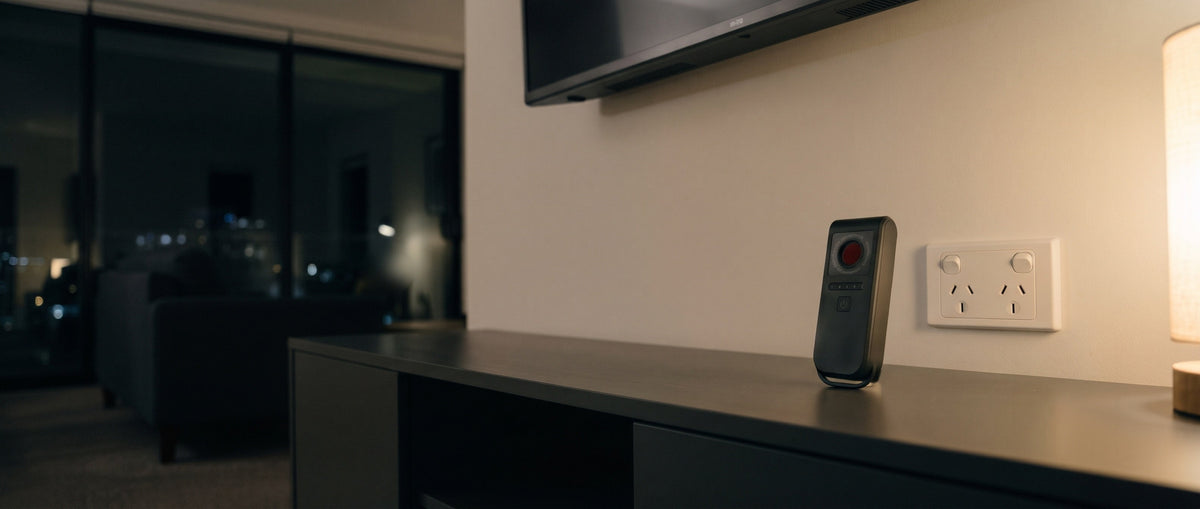
A lens detector is a ring of red LEDs around a small viewfinder. You look through it and sweep the room slowly, and a camera lens bounces that red light straight back as a bright point that blinks as you move, whether the camera is transmitting, recording to a card or switched off. It is slow, because you are scanning by eye, but it finds cameras nothing else will. A signal detector finds any camera streaming over WiFi or 4G in seconds, but is blind to a camera recording locally. Units that combine both are the practical choice for most people.
How to sweep a room
Work methodically rather than quickly. Turn the lights off for lens detection, because reflections are far easier to see in a dark room, and check anything with a view of the bed or the bathroom door first: smoke alarms, clocks, chargers, air purifiers, power outlets and ceiling fittings. In rentals and hotel rooms the recurring places are mains adaptors and USB chargers left plugged in, digital clocks, TV units, power boards and decorative items on a shelf at bed height. A careful sweep of a hotel room takes ten to fifteen minutes.
Compare the types
 Lens finder only |  Lens and RF combined |  Professional RF | |
|---|---|---|---|
| Finds | Any lens, transmitting or not | Lenses, transmissions and magnet mounted trackers | Transmissions, identified by band |
| Misses | Microphones and trackers | Devices switched off in a cavity | Cameras recording to a card |
| Battery | 25 hours on one job | Check the listing | Check the listing |
| Suits | Hotel rooms and rentals, one clear job | Most people checking their own space | Regular sweeps of offices and meeting rooms |
| See | Lens finder detector | Combined bug detector | iProtect 1216 |
Buying guides
 Counter-Surveillance Buying Guide AustraliaHow to find hidden cameras, bugs and trackers
 How to actually sweep a roomJump to this section of the Counter-Surveillance Buying Guide
 The offline voice recorder problemJump to this section of the Counter-Surveillance Buying Guide
Related
Counter Surveillance Listening Device Detectors GPS Tracker Detectors Non-Linear Junction Detectors
Common questions
Will it find a camera recording to a card?
Only lens detection will. A signal detector needs the camera to be transmitting.
Does it work through walls?
Signal detection can pick up transmissions from an adjoining room. Lens detection needs line of sight, which is why a slow sweep from several positions in the room beats one quick pass.
Can I check a room without buying anything?
Partly. Lights off, curtains drawn, then sweep a torch slowly across every surface at eye level: a lens returns a small, hard, bright point that moves as you move. Check the WiFi list on your phone as well: a camera that creates its own hotspot may show there, although one joined to the property's router will not. A detector makes both faster and more reliable.
Is it legal to sweep for hidden cameras and bugs in Australia? Australian law
Yes. Owning and using a detector needs no licence, and sweeping a room, a car or an office you control, or one the occupier has asked you to check, is lawful. If you find something, leave it where it is, photograph it and contact the police, because the device may be evidence. Surveillance devices laws differ by state and territory, but a hidden camera where people expect privacy, a listening device on a conversation the person who placed it is not part of, or a tracker fitted to your car without your consent is generally not allowed.